
The role of internal dialogue in deep point of view is often skimmed over, but your ability to write a character’s thoughts in a way that captures their voice, emotion, intention drives the emotional journey of the story. The key to great internal dialogue in deep pov is keeping it organic.
Intimately Know Your Character
How well do you know your character? So many times, the internal dialogue reflects the most surface-level thoughts and emotions your character may be experiencing. There is so much more to become curious about and really explore. The more you know your character, the more you understand what ELSE is going on. If you’ve been told “go deeper” this is a great place to start.
Internal dialogue should reflect a character’s fears, motivations, and priorities in any given scene. Showing internal conflict, escalation of tension, and what’s at risk for your character without author summary or explanation is going to take some practice.
Example:
Her finger circled the rim of the glass again, slow, deliberate.
What was she hiding? “You’ve been quiet all night.” He forced the cheer into his voice. He’d only been late for dinner once this week.
Let’s focus on the internal dialogue. Where could we go deeper by asking what ELSE is going on here? Ask if the reader might already have any of this information? Repeating what the reader already knows doesn’t move the story ahead, so unless you’re doing the repetition intentionally, go deeper.
The rhetorical question is a red flag that we might be using summary to avoid the work of going deeper. We could try answering the question instead? We could go deeper into describing what the character is seeing and his reaction to it. We could dive into his sensory experiences to show how he’s feeling, what priority this moment has, what risk he attaches to this moment.
The Fix:
Her finger circled the rim of the glass again, slow, deliberate.
She couldn’t avoid looking at him all night. “You’ve been quiet. What’s on your mind?” He recrossed his ankles under the table and turned the glass between his fingers, stifling a yawn. They could work this out. He just had to pry from her what he’d done wrong this time.
She glanced up at him finally, her mouth not quite smiling. “You can’t really not know why I asked you here.” She waved a finger between them. “This…” She leaned in. “Whatever this is now. It’s not working.”
Deep POV is going to add to your word count, so be strategic with where you go deep — and how deep you go. But do you see how the second example pulls you in more? You have more insight into what’s important to that character, how he’s misread the whole situation and it’s probably not the first time!
Make Internal Dialogue Organic
We feel like thoughts randomly pop up in our minds, but in reality there’s a thread that links them all. That thread may zip through our minds in an instant and only make sense to us, but it’s there. It could be a word that triggers a memory, or the topic brings to mind a discussion that wasn’t resolved, or maybe there’s some commonality about the people, the place, the season, the colour palette, a smell… You get the idea. Take your reader on that journey.
These insights can bog down your story, but if you’re strategic with them, they can show what’s important to your character. These rabbit trails or word association games our minds play can show tenacity, creativity, passion, fear, anxiety, and longing.
“Do you want pizza or pasta tonight?” Mia held up the two different takeout menus.
Leo’s eyes lit up. “I think we should get a Vespa!”
Mia rolled her eyes. “Pizza.” She held a dramatic pause and held up one menu. “Or pasta?” She lifted the other menu.
We need the internal dialogue here to make sense of what’s going on. Mia doesn’t have to know what thread in Leo’s head led to his statement, but it needs to make perfect sense to Leo.
“Do you want pizza or pasta tonight?” Mia asked.
The picture of the Leaning Tower Of Pisa on the pasta menu caught his eye. Italy. The blond, hair flying behind her zooming past on a Vespa as he’d sipped a latte in the Piazza del Duomo… Mia’s arms wrapped around him as he drove them through the streets of Italy would be totally romantic. Leo’s eyes lit up. “I think we should get a Vespa!”
Now the reader can follow the thread Leo’s thoughts took and it makes sense, even though Mia may be completely lost. There needs to be an organic thread to the next thought, even if it only makes sense to the POV character.
The Example:
“You never answered my question about moving,” Lila sank into the sofa next to him.
Mark rubbed the back of his neck. She needed to just let this go. There was nothing wrong with this place. “It’s too expensive to move! OK?”
Lila recoiled, her gaze falling to her lap. “Yeah. Sure.” She rolled out of the sofa and shut the bathroom door behind her. The lock clicked into place.
This is a great example. What ELSE is going on in this scene for Mark? He’s repeating excuses he’s made to Lila and himself repeatedly – most likely, but his responses shut down the conversation. If this a significant plot point and worth going deeper with, let’s explore what ELSE is going on! What’s at stake for Mark? Why is he so resistant?
Mark is repeating excuses that he know will shut down the conversation with Lila. WHY is this conversation uncomfortable? Is there something from his past that he’s trying to avoid? What would a stronger Mark do in this situation? Why doesn’t he do that? What does he think it says about him, that he doesn’t do that better thing?
How does Mark FEEL? He carries tension in his neck — does the tension escalate (grow worse) in this scene? Does he deny the tension? When you ignore or deny emotions long enough, it begins to show up physically in other ways. Does he have tooth aches from clenching his jaw so much? Does he have stomach upset, or trouble sleeping, or a weird tick somewhere that just gets worse and worse?

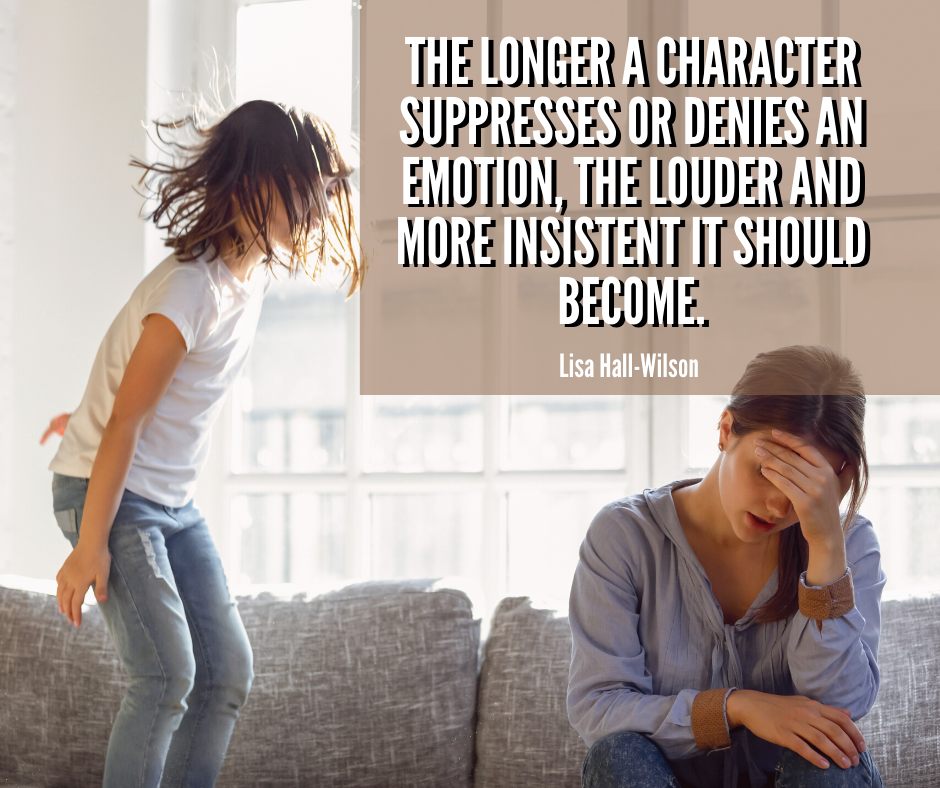
Show his tension through his body language. Does he bounce a knee or tap his fingers on a table? What would his body language look like if he was shutting down emotionally? Someone who is closed off might have their arms crossed, legs crossed, shoulders hunched, avoid eye contact, they may leave. They may get angry as a way to feel more in control and change the subject.
WHY? Why specifically is he angry? What emotion is fueling the anger?
Show The Internal Tension Through Sensory Details
This is one of the most overlooked aspects of what to replace the author summary or explanation with in deep POV. Don’t tell readers how the character feels, SHOW what they’re feeling. Lean into internal sensations, tension points, and let the internal dialogue SHOW the risk, the potential consequences, the past experiences, etc.
Avoid the temptation to summarize the past, remember in deep POV the character is alone in their own head. We don’t need to tell ourselves what happened in the past, just write the internal dialogue in such a way that the past experience can be inferred. Unless the specific details of the past are relevant, instead focus on why the past is interfering or influencing the present.
Example:
Leah crossed her arms. He doesn’t even realize how much he hurt me.
This is interesting because it could be just fine as is, or you could go much deeper if the story needs you to. Why does it matter to Leah if this guy realizes the hurt he’s caused her? What’s behind that? Maybe she’s just a bitter person and routinely grumps and snips at the world.
Or maybe she still cares. Maybe she can’t show how much she’s been hurt for whatever reason – maybe this guy is her boss, or her Dad, or the fiance she still loves and isn’t willing to acknowledge he’s toxic. Exploring the WHY behind this thought can help us add some flesh to the bare bones, so to speak.
Is this thought a reflection on Leah, or the guy? Does this show us she feels insignificant or invisible?
Now, let’s add some sensory and/or internal sensation details. I’m often asking people to be specific and particular with the emotions. What does THIS character feel RIGHT NOW in THIS time and place? Being specific and particular is going to help us show the intensity, the risk, the past, all the things.
The FIX focusing on body language:
Leah cinched her arms tight across her chest, a shield against the hollow ache spreading inside her chest. Heat burned in her throat, forcing her eyes to sting with tears — but he didn’t even glance up. Of course he didn’t. She turned away, her heels dragging with each step. To him she was air, just always there and not worth noticing.
The FIX focusing on hiding how she feels:
Leah forced her arms to relax at her sides and drew in a strangled breath through her raw throat. Don’t say anything. You are fine. Totally fine. What he thinks doesn’t matter, doesn’t define you. She bit down on her lips for a moment and pictured the lavender plant outside her window. She smiled, a soft genuine smile. His gaze landed on her for a moment, pausing. She wouldn’t look away, she wouldn’t make it easy for him, but his actions did not decide her emotions. Her fingers curled into the fabric of her pants and squeezed until the heat of her hands left wrinkles in the linen.
Some people are going to point out the slip into second person. That was just a stylistic choice to show internal self-talk. Playing around with juxtaposting inner emotions against behaviour or outward facades are fun and very effective.
I’ve run out of space with this post. I hope you find something helpful here. Where do you struggle most with using realistic and compelling internal dialogue in deep POV?